
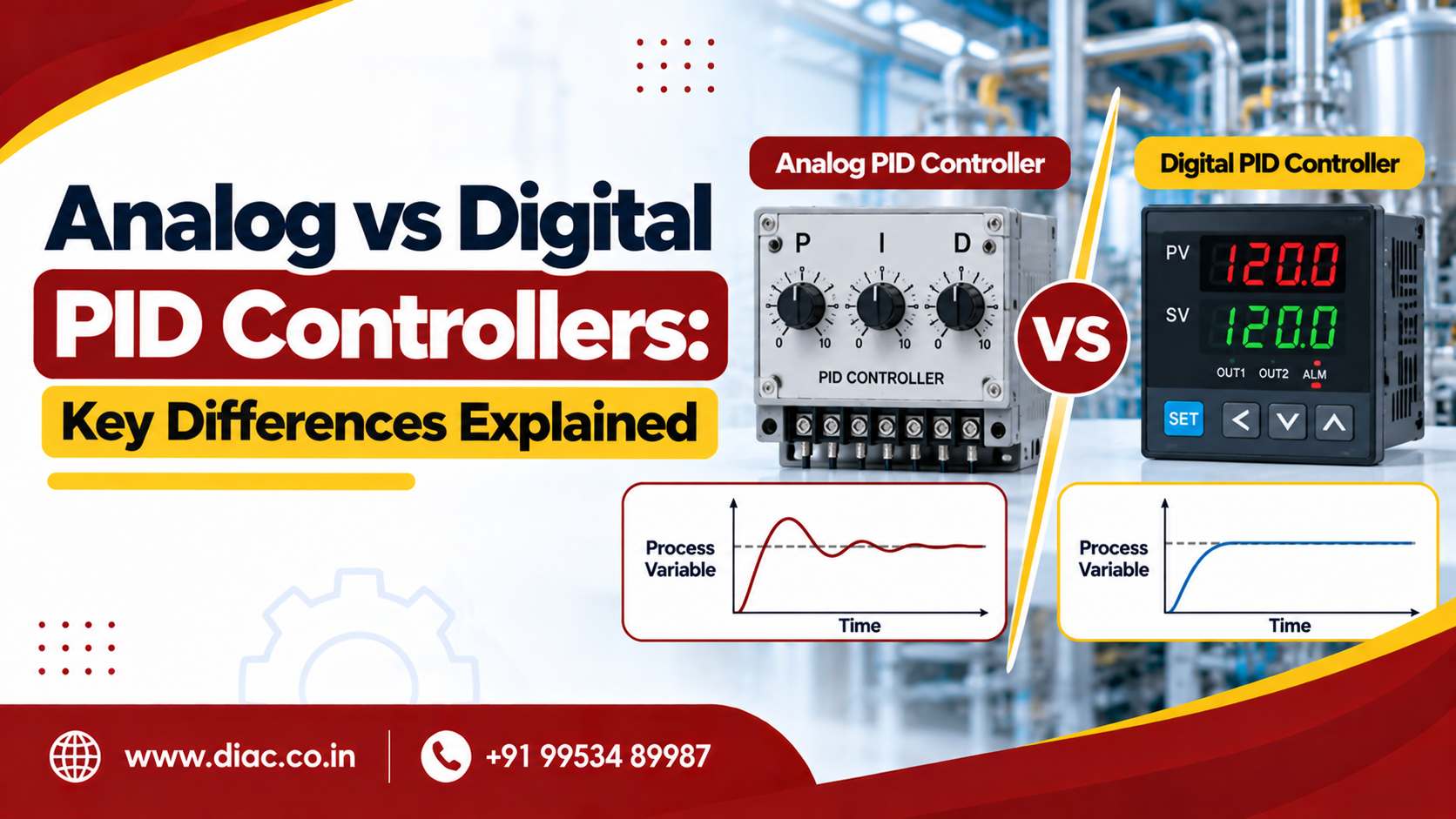
In the world of automation and control engineering, PID (Proportional-Integral-Derivative) controllers are foundational tools. Whether you're managing temperature in a furnace, controlling the speed of a motor, or stabilizing a drone, PID control helps maintain stability and precision. But not all PID controllers are created equal—some are analog, while others are digital. So what’s the difference, and why does it matter?
Let’s break it down.
🧠 A Quick Refresher: What is PID Control?
PID control is a feedback mechanism that calculates an error value as the difference between a desired setpoint and a measured process variable. It applies corrections based on:
-
Proportional (P): Reacts to the current error.
-
Integral (I): Accounts for past errors (accumulation over time).
-
Derivative (D): Predicts future errors (rate of change).
Together, these actions aim to minimize error and achieve a stable, accurate response.
Course: PLC, SCADA & HMI Training
⚙️ Analog PID Control Systems
How They Work:
Analog PID controllers use physical electronic components—like resistors, capacitors, and operational amplifiers—to perform control functions. These controllers are typically built using analog circuitry without microprocessors or digital computation.
Key Features:
-
Real-time response: Since there’s no sampling or processing delay, analog systems respond instantaneously to changes.
-
Continuous signals: Everything operates on a continuous-time basis, making them inherently smooth.
-
Hardware-dependent: Tuning is done manually by adjusting knobs or changing circuit elements.
Pros:
-
Ultra-fast response time
-
No aliasing or digital noise
-
Highly reliable in simple, rugged environments
Cons:
-
Limited flexibility and scalability
-
Difficult to tune precisely
-
No programmability or adaptive capabilities
-
Maintenance can be challenging (aging components, drift)
💻 Digital PID Control Systems
How They Work:
Digital PID controllers use software algorithms executed on microcontrollers, PLCs (Programmable Logic Controllers), or computers. The process variables are sampled at discrete time intervals, and mathematical equations are used to calculate the PID outputs.
Key Features:
-
Sampling & computation: Inputs are converted to digital signals (via ADCs), processed, and then outputs are sent (via DACs or digital interfaces).
-
Easily programmable: Parameters can be adjusted through software or user interfaces.
-
Advanced features: Can integrate filtering, adaptive control, machine learning, or remote connectivity.
Pros:
-
Easy to implement complex control strategies
-
Adaptable and flexible for various systems
-
User-friendly tuning and monitoring
-
Can log data and integrate with IoT/cloud platforms
Cons:
-
Sampling delay and potential lag
-
Requires reliable digital hardware and power
-
Subject to issues like quantization and digital noise
🔍 Side-by-Side Comparison
| Feature | Analog PID | Digital PID |
|---|---|---|
| Technology | Hardware (analog circuits) | Software (microcontrollers, PLCs) |
| Signal Type | Continuous | Discrete |
| Tuning Method | Manual (hardware-based) | Software-based (GUI, code) |
| Flexibility | Low | High |
| Maintenance | Hardware upkeep | Firmware/software updates |
| Precision | Limited by components | High, with numeric accuracy |
| Advanced Features | Not supported | Filtering, adaptive control, networking |
| Cost (initial) | Lower (in some cases) | Can be higher |
🧠 When to Use What?
-
Analog PID is ideal for:
-
Legacy systems with no digital infrastructure
-
Simple, high-speed control loops
-
Harsh environments where reliability is key
-
-
Digital PID is better suited for:
-
Modern automated systems
-
Applications requiring adaptability and remote access
-
Integration with industrial networks or IoT platforms
-
🚀 Final Thoughts
The choice between analog and digital PID control systems depends on your application’s needs. While analog systems offer fast and simple control, digital systems unlock a world of flexibility, precision, and functionality. In many modern industries, digital is the standard—but understanding both gives you the power to choose the right tool for the job.
Have you worked with either type of PID system? Share your experiences in the comments—we'd love to hear how you’ve used them in real-world projects!