
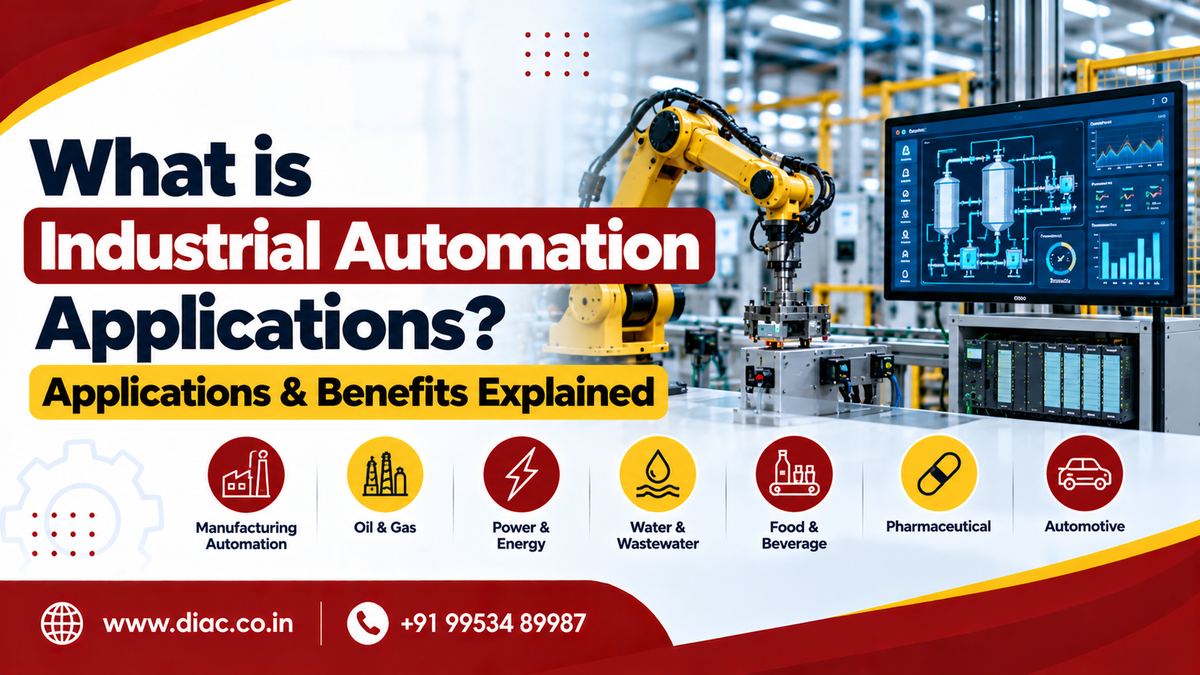
Industrial automation refers to the use of control systems such as PLCs (Programmable Logic Controllers), SCADA (Supervisory Control and Data Acquisition), sensors, robotics, and software to operate machinery and processes in industries with minimal human intervention.
It is a key technology that improves productivity, quality, safety, and efficiency in industrial environments.
🔧 How Does Industrial Automation Work?
Industrial automation systems are designed to:
1. Monitor real-time data from machines
2. Control processes automatically based on pre-set logic
3. Respond to sensor feedback
4. Reduce human error and increase speed of operation
These systems use a combination of hardware (sensors, actuators, drives) and software (HMI, SCADA, DCS) to create a fully automated production environment.
🚀 Applications of Industrial Automation
Industrial automation is widely used in various sectors. Below are the key applications:
1. Manufacturing Industry
One of the largest users of automation, especially in:
-
Assembly lines
-
CNC machines
-
Packaging systems
-
Quality control with machine vision
2. Oil & Gas Industry
Automation helps in:
-
Monitoring pipelines and tank levels
-
Controlling valves and pumps
-
Remote drilling operations
-
Safety and leak detection
3. Automotive Industry
Used for:
-
Robotic welding and painting
-
Engine assembly
-
Automated testing
-
Supply chain automation
4. Food and Beverage Industry
Applications include:
-
Automatic bottling and packaging
-
Temperature and pressure control
-
Ingredient measurement systems
5. Pharmaceutical Industry
Automation ensures:
-
Precise mixing of compounds
-
Sterile filling
-
Batch processing
-
Compliance with regulations
6. Power Plants and Energy Sector
Used in:
-
Power grid monitoring
-
Renewable energy systems (like solar/wind)
-
Load balancing and fault detection
⚙️ Benefits of Industrial Automation
-
✅ Increased Productivity
-
✅ Improved Product Quality
-
✅ Reduced Operational Costs
-
✅ Enhanced Safety
-
✅ Real-time Monitoring & Control
Conclusion
Industrial automation applications are transforming the way industries operate. From assembly lines to power generation, automation improves reliability, reduces costs, and ensures consistent performance. As technology evolves, the scope of automation will continue to expand across sectors.
If you're looking to build a career in this growing field, learning PLC and SCADA systems is a great starting point.
Course: Industrial Automation Training