
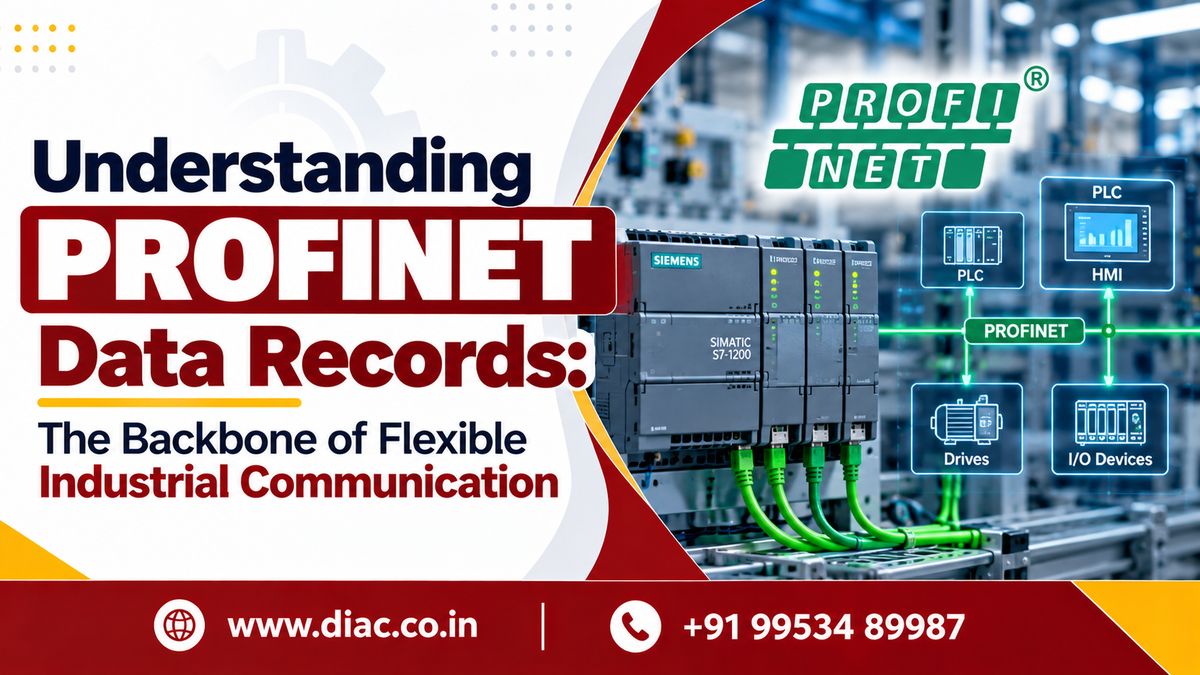
In the world of industrial automation, PROFINET stands out as a robust, Ethernet-based communication standard that enables real-time data exchange between controllers, devices, and systems. While its real-time capabilities are well-known, PROFINET also excels in handling non-cyclic tasks like configuration, diagnostics, and parameterization. This is where PROFINET Data Records come into play. In this blog, we’ll explore what data records are, how they work, and why they’re essential for modern industrial networks.
What Are PROFINET Data Records?
PROFINET Data Records (often called records or DPR) are structured blocks of data used for acyclic communication between devices. Unlike cyclic data (e.g., real-time I/O signals), data records handle tasks that don’t require millisecond precision, such as:
· Configuring device parameters during startup.
· Reading diagnostic information (e.g., error logs, temperature).
· Updating firmware or settings on-the-fly.
Think of them as a "mailbox" system: controllers send or request specific data records to devices when needed, ensuring flexibility without interrupting real-time processes.
Structure of a Data Record
Each data record is uniquely identified by four components:
1. API (Application Process Identifier): A high-level identifier for the application.
2. Slot: Represents a physical or logical module in a device (e.g., an I/O module).
3. Subslot: Further divides a slot into channels or functions.
4. Index: A numeric ID pointing to a specific data record.
For example, a
motor drive’s configuration might be stored in API=1, Slot=2, Subslot=1, Index=123. The record itself
contains structured data, such as:
· Header: Metadata (length, version).
· Slots: Parameter values (integers, strings, arrays).
This modular design allows engineers to access precise data without parsing entire device memory.
How Are Data Records Used?
1. Device Configuration
During commissioning, controllers send data records to set parameters like IP addresses, motion control settings, or sensor thresholds.
2. Diagnostics and Maintenance
Records can retrieve health data (e.g., error codes, operating hours) for predictive maintenance.
3. Firmware Updates
Manufacturers push updates via data records, minimizing downtime.
4. Dynamic Reconfiguration
Adjust device settings on-the-fly without restarting the system—critical for flexible production lines.
Benefits of Using Data Records
· Standardization: All PROFINET devices follow the same data record structure, simplifying integration.
· Efficiency: Acyclic communication saves bandwidth for critical real-time data.
· Flexibility: Supports complex data types (strings, arrays) beyond simple I/O signals.
· Future-Proofing: Enables upgrades and new features without hardware changes.
Real-World Example
Imagine a packaging line with a robotic arm. During setup, the controller sends a data record to set the arm’s speed and torque limits. Later, it periodically reads diagnostic records to monitor motor temperature. If an update is needed, the engineer uploads new firmware via a data record—all without halting production.
Conclusion
PROFINET Data Records are a silent powerhouse in industrial automation, bridging the gap between real-time control and flexible device management. By mastering their use, engineers can unlock greater efficiency, easier diagnostics, and seamless scalability—key traits for thriving in the era of Industry 4.0 and IIoT.
Whether you’re commissioning a new system or optimizing an existing one, understanding data records is a step toward smarter, more adaptive automation.