What is the difference between VFD and servo drive?
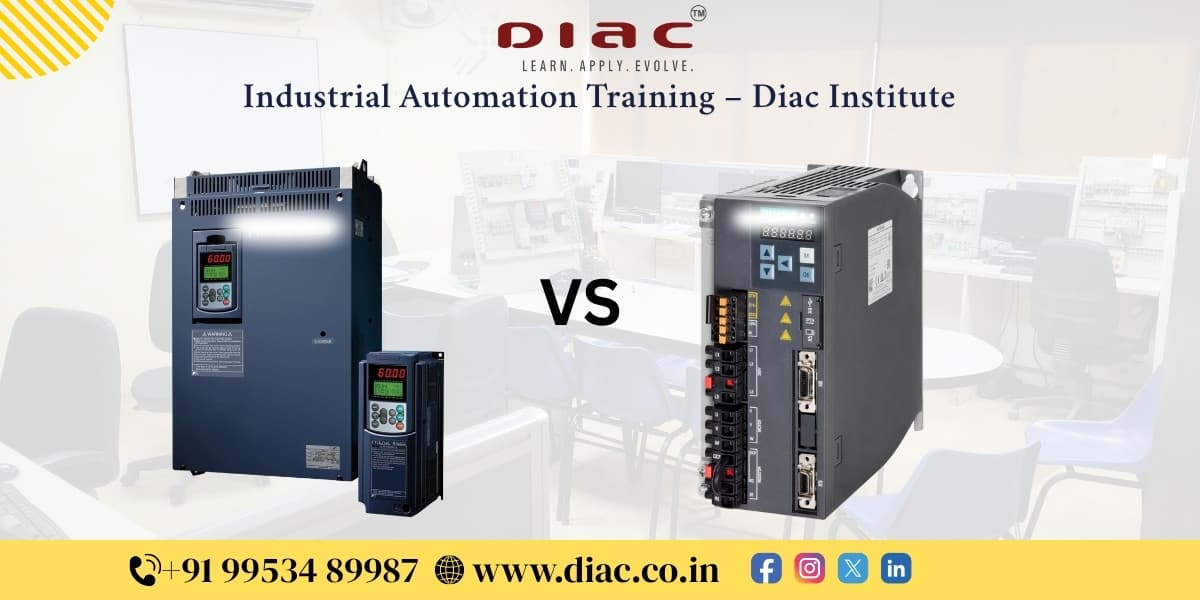
If you spend any time around machines—conveyors, pumps, cutters, pick-and-place robots—you’ll hear two terms tossed around a lot: VFD (variable-frequency drive) and servo drive. Both pieces of hardware control electric motors, both can speed things up or slow them down, and both can make a system more efficient. But they’re built for different jobs, and understanding those differences helps you pick the right tool, avoid overspending, and hit your performance targets the first time.
Below is a plain-spoken tour of how each works, where they shine, where they struggle, and how to decide between them.
The elevator-pitch difference
VFD (Variable-Frequency Drive): Primarily controls the speed and torque of an AC induction motor by varying the frequency and voltage it sends to the motor. Think steady motion, smooth ramps, efficiency, and cost-effectiveness. VFDs excel in applications like fans, pumps, blowers, conveyors, mixers, and general-purpose material handling.
Servo drive: Controls the position, speed, and torque of a servo motor (usually a permanent-magnet synchronous motor) using closed-loop feedback from an encoder or resolver. Think precision, fast response, repeatability, and complex motion profiles. Servo drives rule in CNC machines, robotics, electronic assembly, packaging with indexing, and any place you need tight positional control and quick changes.
What’s inside and how they work
VFD basics
A VFD has three main stages:
Rectifier: Converts incoming AC line power to DC.
DC bus: Smooths and stores energy in capacitors (sometimes with a reactor for filtering).
Inverter: Uses high-speed transistors (IGBTs) to create a synthesized AC waveform at a commanded frequency and voltage.
By changing the output frequency, the VFD changes motor speed (speed is roughly proportional to frequency for induction machines). Early VFDs used simple V/Hz (scalar) control, which is great for steady-state loads but mediocre for dynamic torque changes. Modern units add vector control or field-oriented control (FOC), which better estimates or measures the motor’s magnetic field, improving torque at low speed and responsiveness. Some VFDs can use an encoder for “closed-loop vector” control, but even then, they’re still not optimized for high-precision positioning; they’re tuned for speed/torque regulation on induction motors.
Servo drive basics
A servo system is a matched set: servo drive + servo motor + feedback device (encoder/resolver). The servo drive also rectifies AC to DC and inverts back to a controlled AC, but the crucial difference is the control loop:
Current (torque) loop regulates torque quickly.
Velocity loop regulates speed using feedback from the encoder.
Position loop regulates where the shaft is, often at higher-level motion controllers (though many servo drives include it).
Because a servo sees actual rotor position and speed in real time, it can correct errors immediately. That’s why you get high stiffness, tight following error, fast acceleration/deceleration, and precise positioning. Servos routinely run complex motion profiles—s-curves, cams, electronic gearing—while holding microns or arc-minutes of accuracy (motor and mechanics permitting).
Motor types and matching
VFDs are designed for AC induction motors (squirrel-cage). Increasingly, many VFDs can also run permanent-magnet synchronous motors in a basic way, but their sweet spot remains induction machines for general-purpose duty.
Servo drives are paired with servo motors (permanent-magnet synchronous motors with low inertia and high torque density). The motor and encoder are specified as a set, with torque-speed curves, peak overload capabilities, and thermal limits tightly documented.
VFD: Speed control, torque control, and energy savings. You can ramp smoothly, maintain a set RPM, and handle moderate load disturbances. Positioning with a VFD is possible in a crude sense (counting time or using external sensors), but it’s not what they were built for. Servo: Positioning first, speed and torque as equal citizens. You can command “move 123.45 degrees,” “follow this cam profile,” or “hold at 0.001 mm.” Servos can also do pure torque mode (e.g., capping machines) with fine limits and quick response. Acceleration/Deceleration: Servos deliver much higher torque-to-inertia ratios and short-term overload (often 300% rated torque for a few seconds), allowing rapid starts and stops. VFDs can ramp quickly too, but induction motors typically offer less peak torque and slower response. Low-speed behavior: VFDs on induction motors lose torque at very low speeds (unless using closed-loop vector with encoder). Servos maintain full torque down to zero speed and can hold a position (with control current) without drifting. Repeatability: Servo systems use encoder feedback to land at the same spot over and over. VFDs target a speed; position repeatability must be handled by external sensors or mechanical stops. VFD: Speed accuracy is good, especially with vector control and an encoder—often good enough for process control and steady mechanical power. Position accuracy isn’t their domain. Servo: Encoder resolution (from a few thousand counts per rev up to millions with high-resolution encoders) enables fine granularity. Combined with tight control loops, you get high accuracy and repeatability, limited mainly by drivetrain backlash and compliance. VFD setup is usually simpler. You’ll set motor nameplate data (voltage, current, frequency), choose a control mode (V/Hz, sensorless vector, closed-loop vector), run an auto-tune, and set ramps and limits. Many applications run great out of the box. Servo setup involves tuning control loops (current, velocity, position), handling inertia matching, and sometimes adjusting notch filters to suppress resonances in the mechanics. Modern auto-tuning tools help a lot, but a good result still benefits from understanding the machine’s stiffness, loads, and couplings. Hardware cost: VFD + induction motor is generally cheaper per kilowatt than servo hardware. System cost: If you need precise motion, attempting it with a VFD can explode costs in sensors, mechanical precision, and programming time—often surpassing a proper servo solution. Integration: VFDs are easy to add for energy savings and basic control. Servos require tighter integration with a motion controller or PLC, but give you richer capabilities. VFDs are famous for slashing energy use on variable-torque loads (fans, pumps) by reducing speed instead of throttling with valves or dampers. Energy scales roughly with the cube of speed in those applications, so small RPM reductions can mean big savings. Servo systems can be efficient too, especially for intermittent motion where the ability to accelerate/decelerate quickly shortens cycle times. Regenerative braking options can send energy back to the DC bus or line (depending on hardware). Still, if your only goal is steady-state flow control, a VFD typically provides the best energy ROI. VFD + induction motor: Some short-term overload is available, but sustained high torque at low speed can lead to overheating. To hold position, you often need a mechanical brake or let the motor continually draw current (inefficient). Servo: Designed for high peak torque and precise holding using active control. Many setups can hold position without a physical brake (though vertical axes still use brakes for safety). Both devices use high-frequency switching, so EMI and harmonic distortion are considerations: Use proper cable shields, grounded motor cables, output reactors or dv/dt filters where needed. For long motor leads, talk to your vendor about reflected-wave mitigation. On the line side, harmonic filters may be necessary for certain installations and compliance. VFD + induction motor is a very robust combo. Induction motors have no brushes or permanent magnets, and they’re widely available in harsh-duty variants (IP66, explosion-proof, etc.). VFDs need standard care: keep them cool and clean; watch capacitors and cooling fans over the years. Servo systems are reliable but more sensitive to environment and wiring. The encoder feedback cable is critical; mechanical shocks, cable flexing, and contamination can cause issues. Plan your cable management and enclosure protection accordingly. Both support safety features: VFDs: Often include Safe Torque Off (STO); some add safe limited speed or safe direction with additional modules. Servos: Commonly offer STO and, in higher-end models, SLS/SLD/SLP (safe limited speed, direction, position) that simplify safe motion without external relays. Always verify the safety integrity level (SIL/PL) to match your risk assessment. Choose a VFD when: You’re running fans, pumps, blowers, compressors. You need a conveyor with smooth starts/stops and stable speed. You want energy savings with minimal complexity. You can tolerate modest speed regulation and don’t need precise position. Choose a servo when: You need precise positioning or synchronization (electronic gearing/camming). The machine requires rapid start-stop cycles and tight following error. You’re doing pick-and-place, labeling with registration marks, CNC, or packaging with index. The load is inertial and demands high peak torque. Core job: VFD: speed/torque control of induction motors. Servo: position/speed/torque control with encoder feedback. Feedback: VFD: optional; often open-loop (sensorless). Servo: mandatory; closed-loop by design. Dynamics: VFD: moderate; good for steady or gently varying loads. Servo: high; built for rapid, precise moves. Accuracy: VFD: speed accuracy; minimal positioning accuracy. Servo: high positional accuracy and repeatability. Cost: VFD: lower initial cost. Servo: higher, but justified when precision and cycle time matter. Commissioning: VFD: usually simple. Servo: tuning required; richer tools and options. “A VFD can do everything a servo can if you add an encoder.” “Servos are only for tiny loads.” “Energy savings always favors servos.” Ask yourself these questions: Do you need to control position directly? If yes, start with a servo short-list. How fast must you accelerate and decelerate? Frequent, rapid moves point to servo. Is the load mostly steady and predictable? That suggests a VFD. What accuracy and repeatability are required? If you’re measuring in millimeters, degrees, or counts—and need to hit it—servo is safer. What’s the duty cycle? High peak torque with short bursts favors servo; continuous moderate torque at fixed speed is VFD territory. What’s your budget and integration time? VFDs are cheaper and simpler; servos cost more but deliver capability that might save time elsewhere. What environment are you in? Harsh and dirty favors rugged induction motors. Servos can work there too with proper protection, but details matter. Move stuff at a controlled speed? Use a VFD. Put something exactly where it needs to be, fast and repeatedly? Use a servo.Control goals: speed vs position
Dynamic performance and responsiveness
Accuracy and resolution
Tuning and setup
Cost and complexity
Energy efficiency
Overload and holding torque
Noise, EMI, and harmonics
Reliability and maintenance
Safety and standards
Typical applications
A quick comparison snapshot
Common misconceptions
Closed-loop vector improves speed and torque regulation, but not to true servo-grade positioning. You still lack the high-bandwidth position loop, high-resolution feedback handling, and motor characteristics optimized for rapid dynamic moves.
Servos scale surprisingly high—tens or even hundreds of kilowatts exist—though cost and application fit still matter. For massive constant-torque applications, a VFD with a right-sized induction motor is often more economical.
Not automatically. For variable-torque HVAC loads, VFDs typically deliver the biggest savings for the least money. Servos shine when cycle time, gentle product handling, or precise motion reduce overall production energy per part.How to choose for your project
A practical rule of thumb